Industrial Paving for Warehouses & Loading Docks in Fresno
Semi-trucks, forklifts, and shipping containers will destroy the wrong pavement in a year. Here's how we spec industrial jobs.
Key Takeaways
- Industrial pavement must be engineered for truck and forklift loads, not standard parking lot traffic.
- A deep, properly compacted aggregate base is what keeps heavy-duty asphalt from rutting and cracking.
- Concrete approach pads at dock faces absorb the highest impact areas and protect surrounding asphalt.
- Drainage and grading planning prevents standing water that shortens pavement life.
- Phased scheduling keeps warehouses and loading docks operating during construction.
Spec for the load, not the budget
Industrial paving lives or dies on the sub-base. A warehouse or loading dock is not the same as a typical parking lot. Heavy trucks, delivery vehicles, forklifts, trailers, and constant loading activity put significantly more stress on the pavement. That is why the right paving system starts below the asphalt.
We typically spec 8–12 inches of compacted Class II aggregate base under 4–6 inches of asphalt for truck-traffic areas. The exact section depends on the expected load, site conditions, drainage, and how the area will be used. Building the pavement around the actual demands of the property helps reduce premature cracking, rutting, settling, and surface failures.
Proper grading and site preparation are just as important as the asphalt itself. Before paving, the subgrade needs to be prepared and compacted correctly so the finished surface has a stable foundation. Poor preparation can cause problems long before the pavement reaches the end of its expected service life.
Concrete where the impact is highest
Loading dock areas take some of the hardest hits on an industrial property. Trucks are turning, backing, stopping, and positioning close to dock doors, which creates repeated point loads and impact in a concentrated area.
That is why concrete approach pads at the dock face can be a practical part of an industrial paving project. Concrete provides a durable surface in the areas that experience the greatest impact and helps protect the asphalt pavement behind it.
This approach can also help create a more functional transition between the loading area and the rest of the paved yard. Instead of treating the entire site the same, we look at how each section is actually being used and build the pavement system around those demands.
Paving for warehouse and distribution traffic
Warehouse and distribution properties need pavement that can handle more than passenger vehicles. Truck lanes, loading areas, staging zones, employee parking, and access roads can all have different traffic patterns and surface requirements.
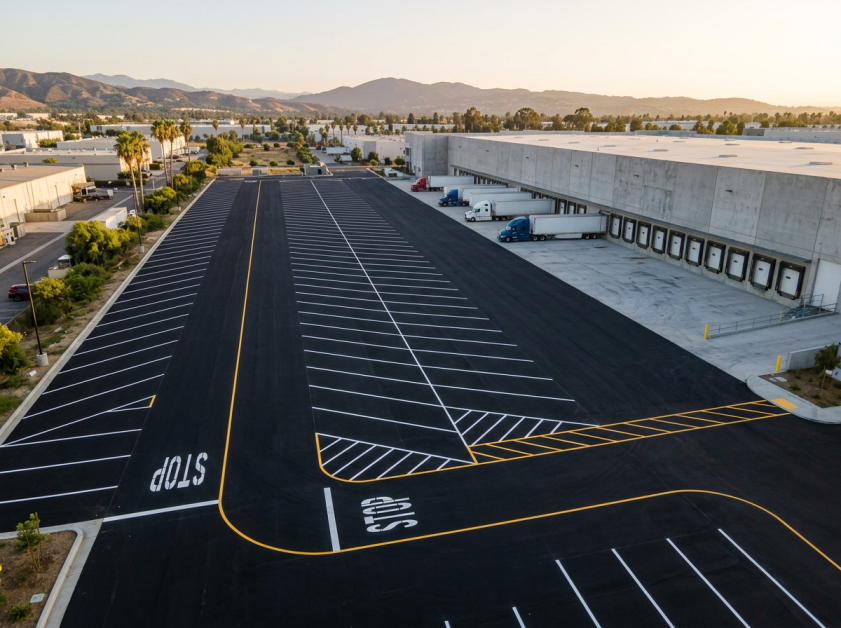
Industrial paving projects can include heavy-duty asphalt paving, parking areas, truck circulation areas, access lanes, loading zones, and warehouse yards. Proper grading and base preparation help create a surface that can stand up to daily commercial use while providing a smoother and more dependable driving area.
Drainage also needs attention during the planning process. Water that collects on or beneath pavement can contribute to deterioration over time. Proper slopes, grading, and site preparation help move water away from critical areas and support the long-term performance of the pavement system.
Striping, signage and safety
The paving is only part of a finished industrial site. Once the pavement is installed, the layout needs to make sense for drivers, employees, visitors, and daily operations.
We finish industrial jobs with high-visibility striping, directional arrows, fire lanes, parking markings, signage, and pedestrian walkways. Clear pavement markings help organize traffic, identify restricted areas, and create defined paths throughout the property.
Pedestrian areas are especially important around warehouses and loading docks where people and heavy vehicles may be operating in the same space. Clearly marked walkways and traffic routes can help make movement around the property more predictable and easier to manage.
Getting the layout right once can save your operations team from dealing with confusion every day. A well-planned industrial pavement system should support the way your property actually operates—not simply look finished when the project is complete.
Build for the next two decades
Industrial paving is an investment in the operation of the property, so the goal should be more than getting pavement down quickly. Site preparation, aggregate base, asphalt thickness, concrete approach areas, drainage, striping, and traffic layout all work together to create a more functional surface.
When the pavement is designed around the real load, the site is properly prepared, and the finishing details are handled correctly, your warehouse or loading dock can have a surface built to support years of commercial activity.
Spec for the load, build the foundation correctly, and get the layout right once. Your operations team will thank you for it for the next two decades.
Frequently asked questions
Juan A. Rodriguez Jr.
Hi, I'm Juan A. Rodriguez Jr., founder of J.A.R Construction Services. With more than 40 years of combined industry experience behind our team, I've dedicated my career to delivering dependable asphalt paving, grading, excavation, and site preparation solutions for residential and commercial properties throughout California. Through my insights, I share practical guidance on pavement construction, maintenance, and site development to help property owners protect their investments and achieve lasting results.